Hull Design
Blending traditional beauty with modern performance
The shape of a hull is a classic case of form following function. If it's right it should be pleasing to the eye from any angle.
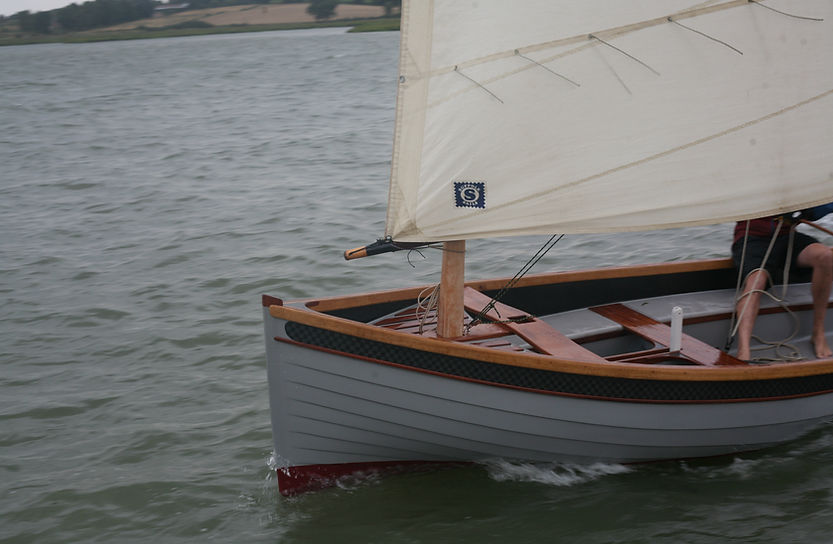
Raedwald's purposeful plumb stem maximises her waterline length, and her fine entry cuts the water effortlessly.
She flares quickly to full shoulders and flat mid sections, generating buoyancy and dynamic lift under the rig, increasing stability and promoting planing.

Her flat mid sections give her tremendous form stability and allow her to plane, easily sailing at more than double her theoretical hull speed.
The full keel adds grip and directional stability to the hull while her moderate rocker still allows her to turn quickly.
The gentle upsweep towards the transom allows the flow of water to release easily from the hull, reducing drag. At displacement speed, she barely produces a wake.

Making the most efficient use of the internal volume of the hull is critical to the experience of sailing the boat.
This boat has been designed for coastal sailing, and safety was the primary consideration when designing the interior.
She is completely double skinned, with self-bailers set into sumps under the thwart. In the unlikely event of the boat being swamped, she is completely self-draining, and because any water in the boat is trapped in the narrow space between the buoyancy tanks, she remains remarkably stable.
Built-in buoyancy has been maximised, without encroaching on the usable space of the cockpit, making her feel much bigger than her modest 15'3"x5'9" dimensions.
The thwart is set flush with the top of the foam-topped seats, making a seamless, comfortable cockpit for 4 or more people to move around easily.
There are optional water-ballast tanks, which can easily be flooded and drained afloat by opening bungs in the hull (accessed through the round hatches either side of the centreboard case). Approx 70kg can be added.
There are large lockers in the front buoyancy chamber, and inspection hatches in the side tanks, which allow for stowage of small items.
There is a tent designed, with a sleeping platform to be tensioned between the gunwales. More on that to follow soon.
Safety and Stability
In out static stability tests Raedwald has proven herself remarkably stable. In the unlikely event of capsizing her (you'd have to be trying really hard!) she can't possibly invert, owing to her buoyant, airtight spars. If you end up in the water, the centreboard is at a height that can easily be reached, and you can see in the first video how little persuasion she needs to come back upright.
The second photograph shows how little water she scooped up after being righted, and this drains within a couple of minutes of sailing with the bailers open.
With almost 200kg of combined weight standing on one gunwale, it won't dip below the water. The third video below shows how much effort it takes to force her to capsize.
All of these tests were conducted with the water ballast tanks empty. With them filled it would be almost impossible to capsize her, and if you did manage it she would self-right.


